
Think about the last time you Googled something important — a software recommendation, a marketing strategy, a product comparison. Chances are, you didn’t scroll through ten blue links. You got an answer. Directly. From an AI.
That’s not a bug. That’s the new normal. And for marketers who’ve spent years obsessing over keyword rankings, it’s a wake-up call.
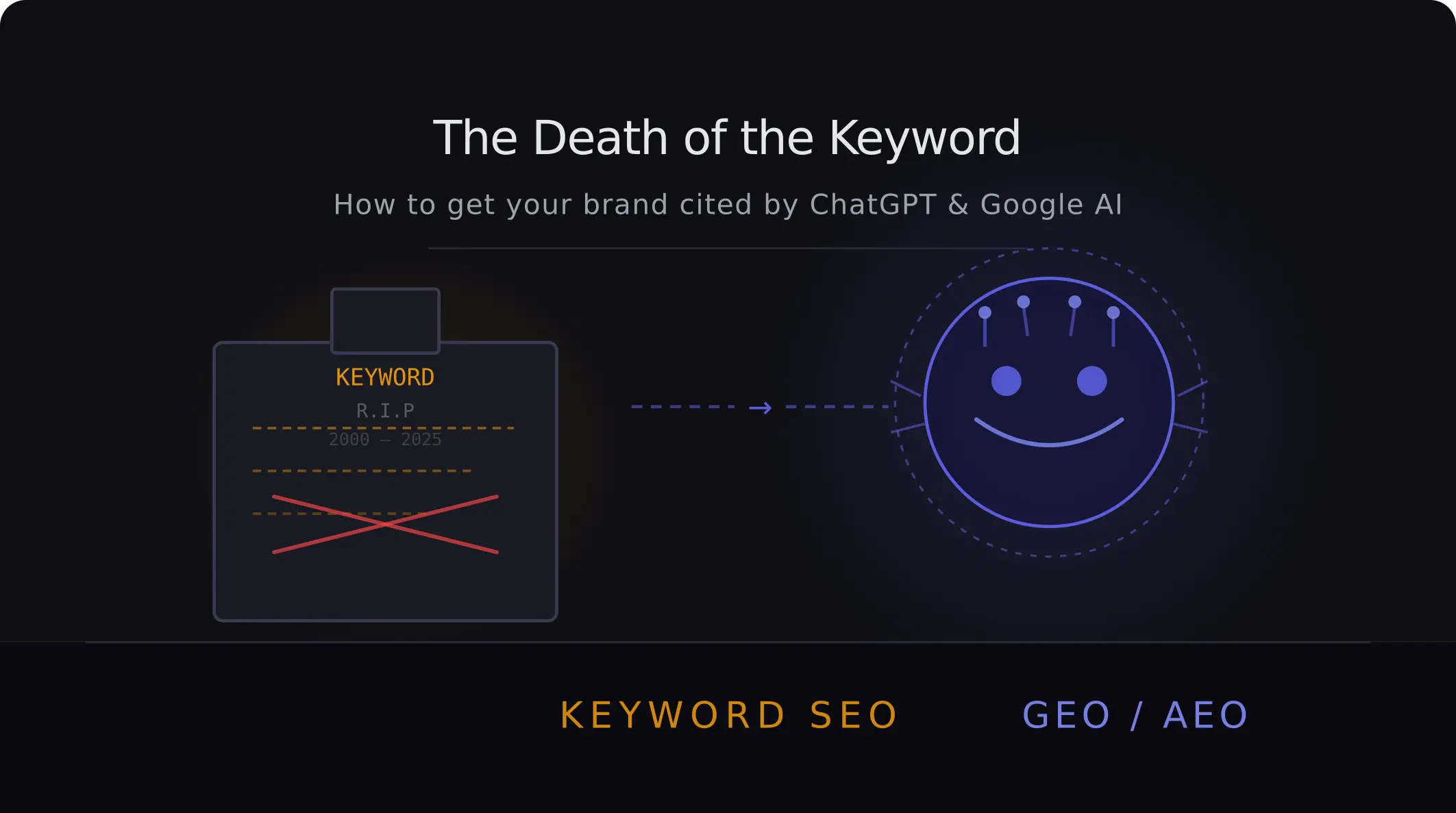
The keyword, as the central unit of search strategy, is dying. What’s replacing it is something far more interesting — and if you move fast, far more powerful for your brand.
What Actually Changed (And Why It Matters Now)
For two decades, the SEO game was simple: find the right keywords, build pages around them, earn backlinks, climb the rankings. The whole ecosystem — content calendars, meta tags, keyword density — was built on this one assumption: people type a keyword, search shows ten links, they click yours.
A 2024 study found that approximately 59.7% of Google searches in the EU and 58.5% in the US ended without a single click — users got their answer directly from the results page. we.optimizz For informational queries — exactly where brands built top-of-funnel awareness for years — AI is now answering the question before anyone clicks anywhere.
And it’s not slowing down. Google AI Overviews now reach 2 billion monthly users, while ChatGPT processes queries from 700 million weekly users. GenOptima These aren’t niche tools. They’re where your customers are going to find their next vendor, service, or solution.
The old playbook doesn’t work here. Ranking on page one of Google no longer guarantees you appear in an AI answer. Research from GEO firm Brandlight suggests that the overlap between top Google links and AI-cited sources has dropped from 70% to below 20%. LLMrefs The game has fundamentally changed.
Meet GEO — The Strategy That Replaces Keyword Stuffing
The discipline that’s emerging to fill this gap is called Generative Engine Optimization, or GEO. GEO is the process of structuring, writing, and publishing content so that AI language models — ChatGPT, Perplexity, Google Gemini, and others — cite it when answering user queries. Traditional SEO optimizes for ranking positions in a list of links. GEO optimizes for inclusion in an AI-generated answer.
The stakes are real. AI-referred sessions jumped 527% year-over-year in the first five months of 2025. Frase Early movers are already reaping compounding returns. Vercel reports that 10% of new signups now come from ChatGPT referrals alone. LLMrefs For some B2B companies, AI tools like ChatGPT have become their single biggest referral source — a channel that didn’t exist two years ago.
The opportunity is wide open. 47% of brands still lack any GEO strategy, giving early adopters a significant window before it becomes table stakes.
How AI Actually Decides What to Cite
This is where most marketers get confused. They assume AI works like Google — crawl, index, rank. It doesn’t.
When someone asks an AI a question, the system doesn’t paste the full prompt into a search engine. It breaks the question into smaller sub-queries and searches for each one separately. LLMrefs Then it synthesizes the most trustworthy, clearly structured sources into a single answer.
Different platforms have different preferences too. ChatGPT’s search feature favors encyclopedic, authoritative content, while Perplexity’s citation patterns skew heavily toward Reddit and recently published content, with a strong preference for articles published within the past 90 days. Google AI Overviews prioritize content that already ranks well organically and has strong E-E-A-T signals.
The common thread across all of them? Brands showing up consistently share specific structural characteristics — entity clarity, content extractability, and multi-platform presence that make them easier for AI systems to find, trust, and reference. Search Engine Land
5 Practical Ways to Get Your Brand Cited by AI
1. Lead with a direct answer. Structure content with direct answers in the first 40–60 words, and maintain fact density with statistics every 150–200 words. Frase AI models are looking for extractable, citable blocks — not long preambles.
2. Build FAQ sections with schema markup. The ideal citable block is 2–4 sentences that answer exactly one question. Use H1→H2→H3 hierarchy, comparison tables, and definition blocks — because LLMs learn from structured patterns. Madhatcomm Adding FAQPage, Article, and HowTo schema tells AI crawlers exactly what information you’re providing.
3. Make your brand an entity, not just a name. Entity-first content structuring means organizing content around clearly defined entities — brands, products, concepts — rather than keyword strings. AI models process information through entity recognition, identifying your brand before they analyze any keyword relevance.
4. Earn mentions across multiple platforms. Reddit, LinkedIn, and YouTube were among the top cited sources by leading LLMs in late 2025. When your brand creates valuable content on these platforms, AI systems have more material to draw from. Search Engine Land Customer reviews on G2, press mentions, and community discussions all signal credibility that AI models reward.
5. Measure with new metrics. Forget rankings. Start tracking “Share of Model” — how often your brand appears in AI responses compared to competitors. Princeton research shows that citing authoritative sources, adding statistics, and including expert quotes can improve AI visibility by 30–40% Digital Applied compared to unoptimized content.
GEO Doesn’t Kill SEO — It Builds on It
Here’s the reassuring part: you don’t throw everything away. Traditional SEO and GEO are complementary. Strong domain authority, backlinks, and technical SEO performance all contribute positively to GEO citation probability. Enrichlabs The content that performs well in GEO — clear, authoritative, well-structured, freshly updated — is the same content that performs well in traditional search.
Think of it as an upgrade, not a replacement.
The brands that will struggle are the ones that keep producing thin, keyword-padded content hoping to rank. The ones that will win are investing in depth, structure, original data, and genuine topical authority — because that’s exactly what AI systems are looking for when they decide who to quote.
The Window Is Still Open — But Not for Long
We’re sitting at an inflection point remarkably similar to 2010, when brands that invested early in SEO built advantages that took competitors years to close. The same dynamic is playing out right now with GEO — except the pace is faster.
Gartner predicts traditional search engine volume will drop 25% as AI-powered search continues its extraordinary growth. ACTGSYS The question isn’t whether your customers will find answers through AI. They already are. The only question is whether your brand is the one giving them.
Stop optimizing for algorithms that rank pages. Start optimizing for AI systems that cite sources. The keyword had a good run — but the brands that thrive next are the ones building content worth quoting.